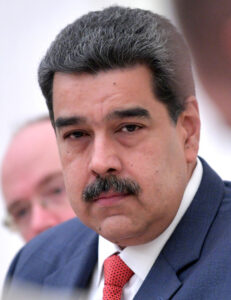
Trump: We will govern Venezuela
The kidnapping of Venezuelan President Nicolás Maduro and his wife, Cilia Flores, by U.S. special forces evokes the sad history of invasions, coups, and U.S. interventions in Latin America and around the world.
The attacks began early Saturday morning with the bombing of several areas of Caracas and concluded with a press conference where an obviously deranged president announced to the world that he intends to govern Venezuela and use its oil to finance his intervention. The words spoken by Trump were identical to those cited by George W. Bush when he began the invasion of Iraq.
Maduro’s kidnapping not only violates international law and U.S. law, but also demonstrates the transformation of the U.S. from a powerful military empire into one where spectacle has become its main weapon to project power.
President Trump declared: “We are going to govern the country,” although there is no evidence of an occupation of Venezuela. The U.S. does not have enough troops to dominate the country, much less control its oil facilities. U.S. infantry, the so-called Marines, are not in Venezuela—they are not deployed at Maiquetía airport, nor at La Carlota, nor at Plaza Bolívar, nor Plaza Venezuela, and certainly not marching through Sabana Grande.
Notably, Trump distanced himself from the Venezuelan opposition. Perhaps he still harbors resentment that the Nobel Prize was awarded to María Corina Machado and not to him. When asked about Corina Machado, he said: “I think it would be very difficult for her to be the leader; she doesn’t have support within the country.”
Last year, Venezuela and the U.S. were negotiating an agreement on deported immigrants and access to Venezuelan oil. A day before his kidnapping, Maduro told Reuters: “If you want to seriously talk about an agreement to fight drug trafficking, we are ready… If you want Venezuela’s oil, Venezuela is willing to accept U.S. investments like Chevron’s, whenever, wherever, and however you want to make them.”
With his typical arrogance, Trump brushed aside comparisons to the old Monroe Doctrine, stating that his actions should be considered a new “Donroe Doctrine.” During the press conference, Trump threatened Cuba and Colombia, but also emphasized “that something will have to be done about Mexico.” The Donroe Doctrine, like the old Monroe Doctrine, implies the subjugation of all Latin America.
Weak and practically senile, Trump has no idea about the history of U.S. interventions in Latin America, nor the details of the Monroe Doctrine and its successors, nor Teddy Roosevelt’s Big Stick policy or gunboat diplomacy. But his advisors do remember.
The grand strategy of Trump’s advisors, especially Secretary of State Marco Rubio and Stephen Miller, is to reestablish U.S. dominance in the hemisphere. They seek to revive the era when the region’s economy and politics revolved around the U.S., and the Marines or the CIA were its diplomatic weapons. “Our dominance of the Western Hemisphere will never again be questioned,” said Trump. But in reality, his illusions of a return to Uncle Sam’s glory days have been buried under an avalanche of Chinese exports.
For now, and with surprising realism, the administration has recognized the limitations of its power. There is no doubt that U.S. military forces can intervene in any Latin American country, but they do not have the capacity to govern a country. Nor can they transform its economy and politics to create a U.S. colony. Trump promises to govern Venezuela and sell its oil, but in practice this will be impossible.
Instead of expanding its effective power, in Venezuela Trump has opted for a war of spectacle. Last year, after his confrontation with Ukrainian President Volodymyr Zelensky at the White House, Trump commented: “This will be good for television.” The kidnapping of Maduro and the new Donroe Doctrine may be “good for television,” but they will not be good for Venezuela, nor for the rest of Latin America.
Emeritus Professors of Pomona College
@mtinkersalas
@victorsilverman.bsky.socialogy