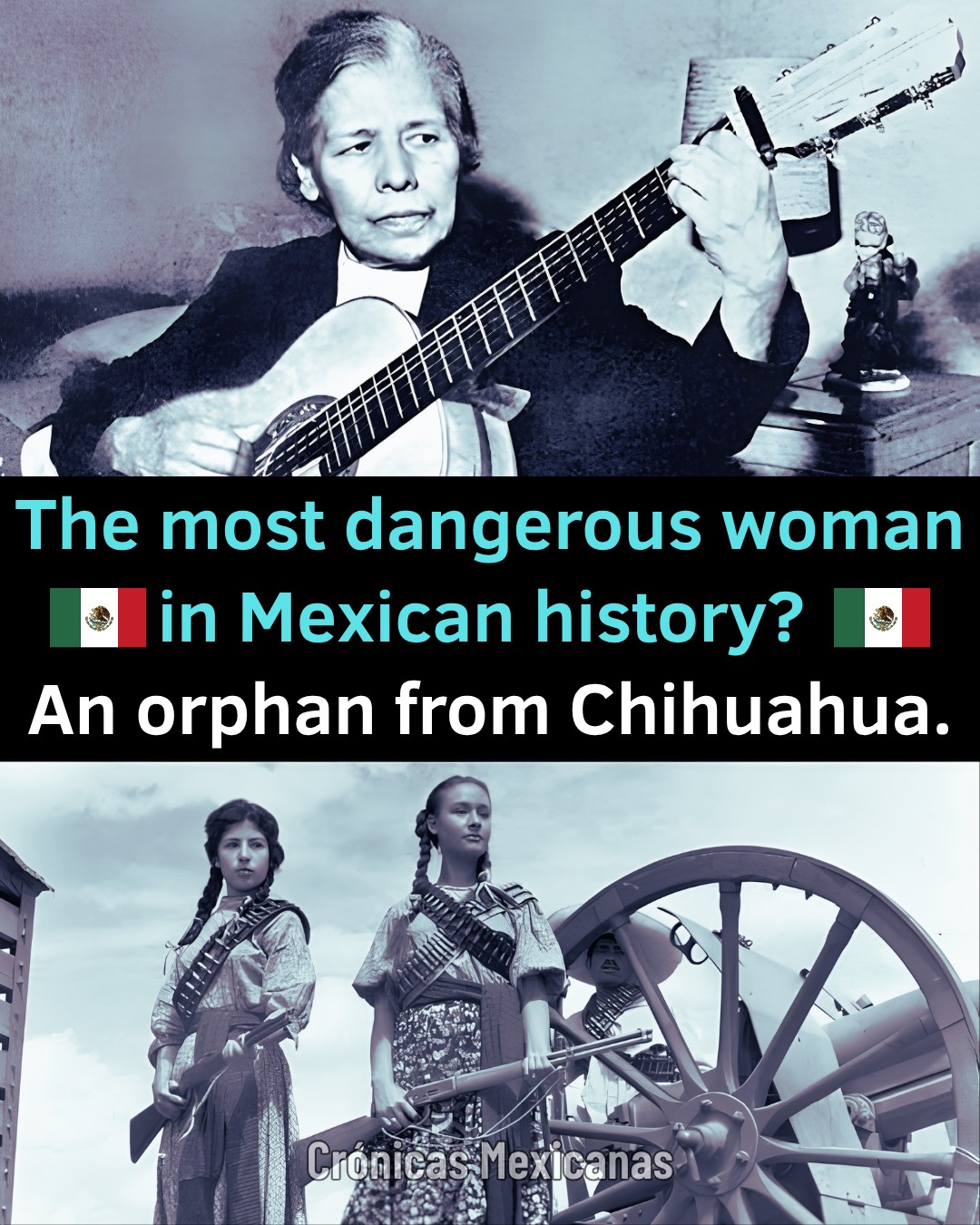
Her real name was Marina Aedo. But history knows her as Graciela Olmos — “La Bandida.” Born in 1895 in Chihuahua, she lived ten lifetimes in one. Most people have never heard her name. That ends today.
AT 12 YEARS OLD, she was orphaned when the Mexican Revolution tore through her home. She ended up in a convent in Irapuato with nothing. The Revolution had taken everything.
Then Pancho Villa’s División del Norte rolled into town.
She fell in love with a revolutionary called “El Bandido,” married him, left the convent, and became a soldadera — marching, fighting, and surviving alongside Villa’s troops. That’s how she earned her name: La Bandida. At the Battle of Celaya in 1915, her husband was killed. The Revolution took from her twice.
What happened next is where it gets truly wild.
 WIDOWED at 19, she changed her name and headed to Chicago during Prohibition — where she linked up with Al Capone’s bootlegging network and became one of the first Mexican women in cross-border alcohol smuggling.
 When U.S. authorities got too close, she cut her hair, disguised herself as a man, and crossed the border back into Mexico with $46,000 cash in a briefcase. Que mujer.
 With that money she built “La Casa de La Bandida” in Colonia Condesa, Mexico City — a legendary meeting place visited by Octavio Paz, Diego Rivera, Agustín Lara, and future presidents. She also gave the women who worked for her classes in literature, gymnastics, and swimming.
 She composed nearly 200 corridos. Her most famous — “Siete Leguas” — honored Pancho Villa’s legendary horse. She launched the careers of Los Panchos, Marco Antonio Muñiz, and Álvaro Carrillo. She literally handed Marco Antonio Muñiz a guitar and told him to go be great. He did.
 She died in 1962 at 66 — having quietly funded an orphanage for years. The woman who survived a revolution, Prohibition, and the underworld spent her final years making sure no child went without.
She moved between worlds few women could enter — the battlefield, the borderlands, the music halls, the underworld, and the salons of Mexico’s elite. And she never asked permission for any of it.