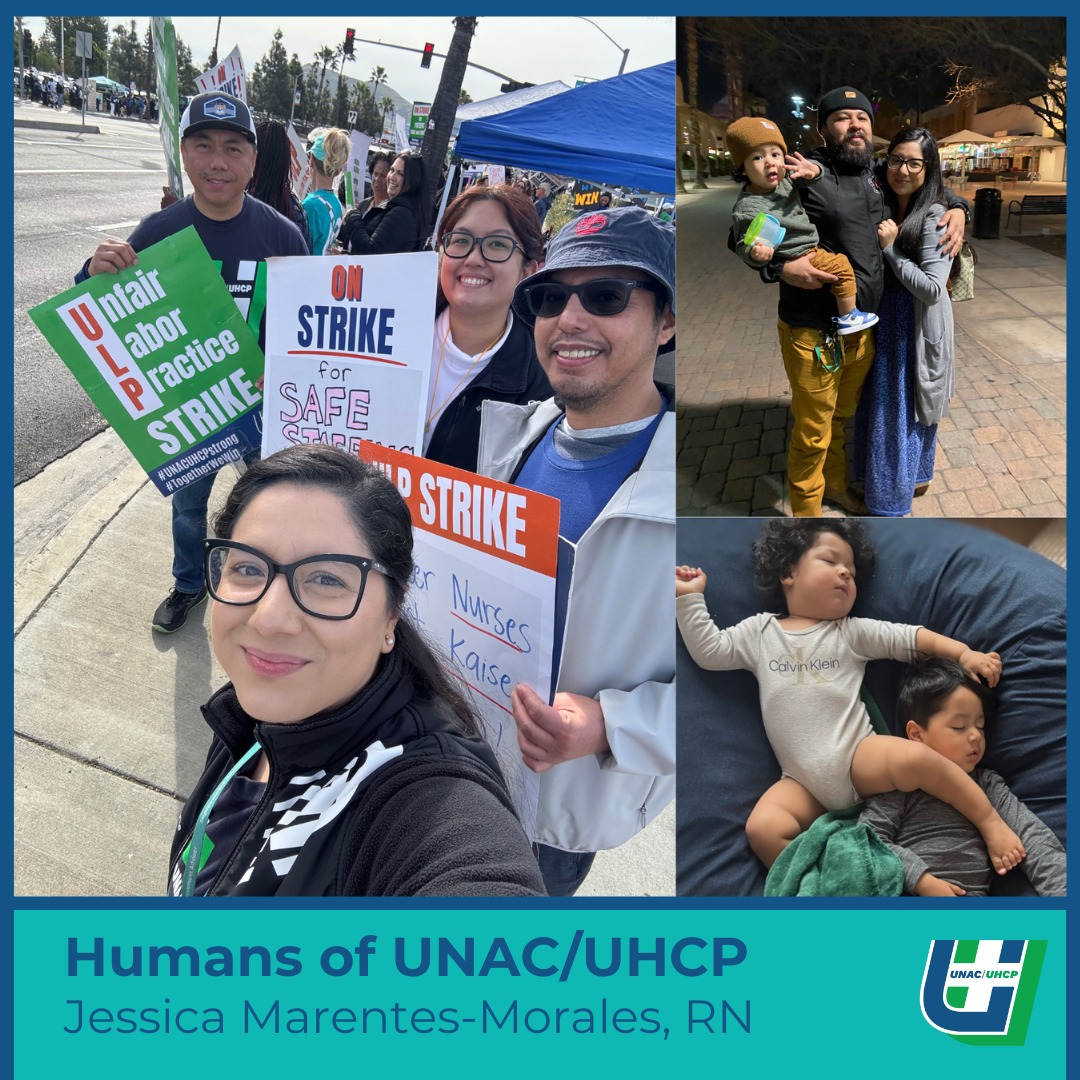
“I’m an oncology nurse at Kaiser Fontana—and I am a member of UNAC/UHCP. Before Kaiser, I was a new grad at Dignity Health, also in oncology. I came to Kaiser thinking I’d finally ‘made it,’ because that’s what everybody says: Kaiser is where you want to be. Kaiser takes care of people. Kaiser pays the most. Kaiser is the dream.
“And then I got here—and I realized the dream has cracks.
“I grew up in foster care. Nothing was handed to me. I didn’t grow up around unions or know what they really meant. I learned what a union is the same way I’ve learned most things in life: by living through what happens when nobody protects you, and deciding I’m not going to be quiet about it.
“My heart has always been in oncology, even though most people don’t pick it on purpose. You don’t graduate nursing school and say, ‘I want to spend my life walking with families through the scariest word they’ll ever hear.’ But it became personal. My mother-in-law died of cancer last year. She was 56. She fought hard. She wanted to be here for her grandkids. She tried. And she didn’t get that time.
“So when I’m at work, I don’t see ‘patients.’ I see somebody’s mom. Somebody’s partner. Somebody who had a normal life until one day the doctor said the big C word, and now nothing is normal.
“In oncology, the people who come to us usually come for a reason: they just found out they have cancer, they’re too sick to manage it outpatient, or they’re in too much pain to be at home. And sometimes… they’re close to transitioning.”
“That’s not abstract to me. That’s not ‘just a shift.’ That’s somebody’s life.
“One night, after running for 12 hours, it was 6:45 p.m. and I was due to leave at 7. A patient looked at me and said, ‘Can you wash my hair? Can you help me bathe?’
“And my first thought was that sounds like night shift’s problem.
“But then I really looked at her. She wasn’t asking for a luxury; she was asking for dignity.
“We were short-staffed. Every call light was a fire, and I was one person. But who am I to deny somebody comfort at the end of their life?
“So I did it. I helped her. I cleaned her. I braided her hair. I treated her like she was my own family.
“She passed away about 30 minutes later.
“A senior nurse pulled me aside and said, ‘Jess, that was a heavenly bath.’
“I didn’t even know what that meant. She told me, ‘Before some people go… all they want is to be clean.’
“I went home thinking, Lord, I’m in the wrong field. You’ve got me confused with somebody else.
“But my husband looked at me and said, ‘Babe, if it’s not you, then who?’
“So I stayed.
“And then life tested me in a different way.
“My husband and I have two little boys—4 and 2—and both are on the spectrum. We fought for answers. We watched our firstborn struggle—sensory issues, not talking, not potty trained—and we knew something wasn’t right.
“The school district diagnosed him before Kaiser did.
“By the time Kaiser confirmed what we already knew, the school had him in programs, therapies, support.
“And I remember feeling this rage in my chest—because when it’s your child, you don’t accept delays like they’re normal. You don’t accept being told, “Just wait.” You don’t accept being minimized.
“I’m a mama bear. Through and through.
“And somewhere in the middle of fighting for my son, I felt something click in my spirit: You need to fight like this for your patients too.
“Because my patients can’t always fight. They’re neutropenic. They’re fragile. Some have no platelets. A fall isn’t just a fall. It can be catastrophic.
“We’ve had falls at Kaiser Fontana. There are days when I feel I’m supposed to be in three places at once. That’s not nursing. That’s unsafe.
“But my morals don’t bend because someone wants a metric.
“I’m the kind of nurse who will sit down and explain the meds. The side effects. The oxygen tank. What to do at home. Why we stopped one medication and started another. If it takes longer than two hours, it takes longer than two hours.
“Because if it’s wrong, it’s wrong.
“And then I hear Kaiser go to the media and say, “This strike is about wages. Our offer is generous. The strike is unnecessary. The union is disrupting patient care.”
“And I’m like—Lord, you cannot serve greed and dignity at the same time.
“I don’t disrupt patient care. I am patient care.
“I clock in every day and meet people where they are—whether they’re fighting for a cure, fighting for comfort, or nearing end of life. I will call palliative again and again if my patient is in agony. I will call speech therapy if my patient is hungry and safe to eat. I will call every unit for help if I need hands to safely get a weak patient out of bed.
“I don’t mess around when it comes to my patients.
“But I need Kaiser to meet us with the same willingness.
“Because I’m not only fighting as a nurse.
“I’m fighting as a mother.
“We bought our first home two years ago. We come from nothing—single-parent homes, foster care, immigrant families. We earned everything we have. And now we’re raising two special needs kids with appointment after appointment—so many that my husband can’t work. I work two jobs to keep us afloat.
“And I’m tired—tired in my bones—of watching health care systems move slow for the people who need speed the most.
“And I’m tired of the truth being sugarcoated.
“If Kaiser wants to know what will move them, I’ll tell you: honest feedback. Real surveys. Real patient voices.
“Because the nurses are doing everything we can with what we’re given. But we’re done pretending what we’re given is enough.
“So yes—I’ll stand on the strike line.
“For my kids.
“For the cancer patients who call us for help.
“For the families who deserve a system that treats their loved ones like human beings.
“We’re willing to meet Kaiser at the National table.
“But we’re also ten toes down.
“Chemo is time sensitive. Safety is time sensitive. This contract is time sensitive.
“And we will not be toyed with.
“If it means going without pay so our community can be safe, we’ll do it—as long as it takes.
“Because if it’s not us . . .Then who?”
—Jessica Marentes-Morales, RN, is an oncology nurse at Kaiser Fontana, and is on strike for patient care.