

So fully respect Jessie de la Cruz and her historic contributions. My students always learned about her in my classes through a book written about her and through the stories of her son – our brother en la lucha – Roberto Bobby de la Cruz who spoke in my classes about her. Jessie de la Cruz – Presente!
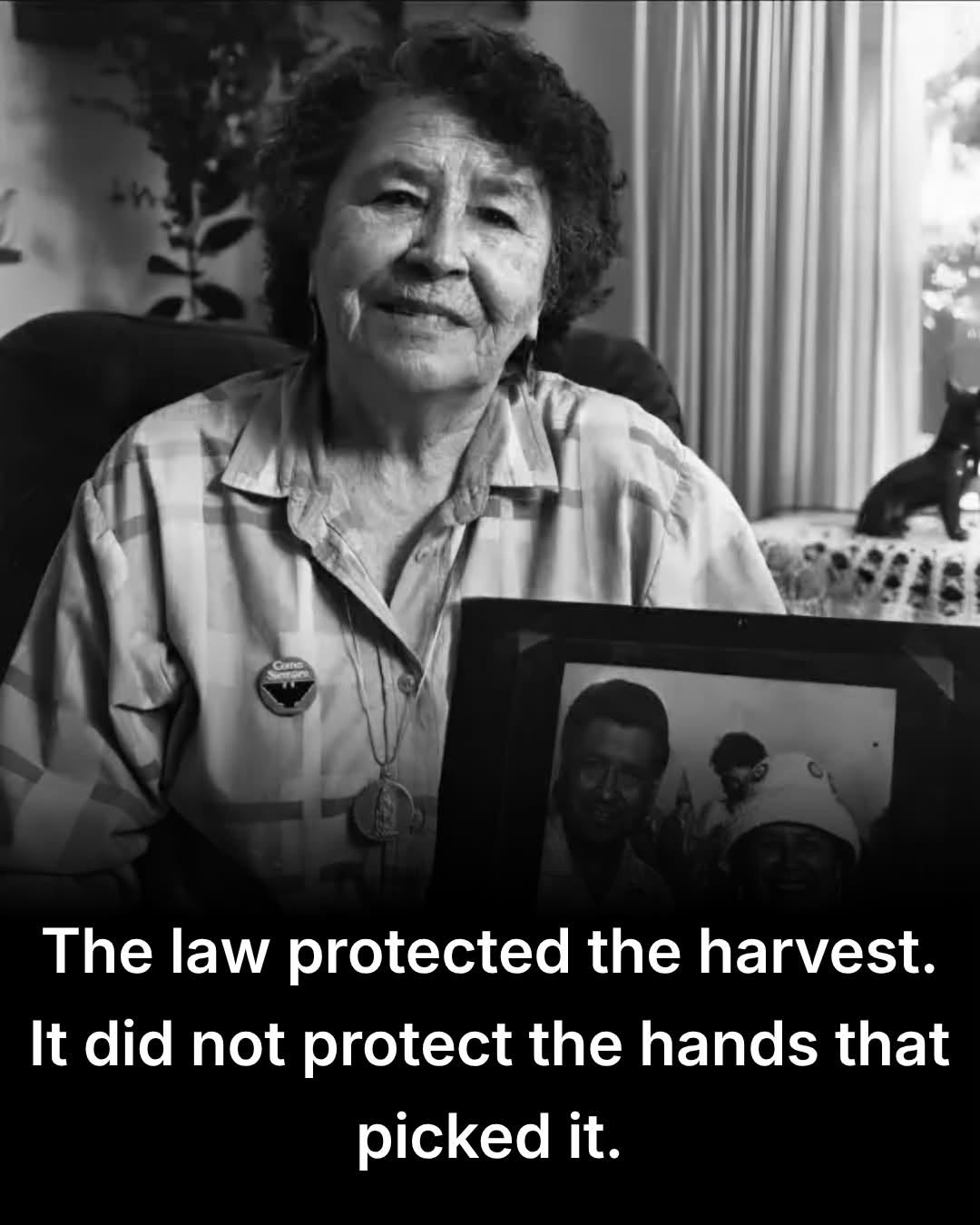
In 1962, the first female United Farm Workers organizer was a 43-year-old grandmother in Fresno County. She had been picking cotton since she was five. Her hands were scarred. Her back ached constantly. The men who owned the land had politicians on speed dial.
Jessie Lopez de la Cruz knew the unwritten rules of the San Joaquin Valley. You worked until your body gave out. She had been in the fields since 1924. She remembered living in a tent made of grain sacks. She remembered the winters when there was no work, boiling wild mustard greens just to put something in her children’s stomachs.
The primary instrument of their daily lives was el cortito, the short-handled hoe. It was exactly twenty-four inches long. It forced you to bend double in the dirt for ten to twelve hours a day. The growers claimed it made workers more careful around fragile root systems. In reality, it was a tool of surveillance. A foreman sitting in a pickup truck could look across a fifty-acre field and instantly see who was resting. If you stood up to stretch your spine, you were fired. If you complained about the lack of drinking water, you were evicted from the labor camp. There was no safety net. You were paid by the bucket. If you didn’t fill it, you didn’t eat.
The secret meeting happened in her living room later that year. Arnold, her husband, had invited a man who wanted to talk about something dangerous. A union.
Jessie sat in the back of the room. She was exhausted.
The man spoke quietly. His name was Cesar Chavez. He didn’t yell. He didn’t promise them money. He didn’t promise them safety. He laid out a mathematical reality about power. The growers owned the land. They owned the housing. They controlled the local police. The workers only owned their hands.
But if enough hands stopped moving, the system would break. The crops would rot in the dirt. The wealth of the valley depended entirely on their invisible labor.
Jessie listened. She looked at her own hands. She looked at the faces of the other workers in her house. They were terrified. They had every reason to be.
Under the National Labor Relations Act of 1935, American workers were granted the legal right to form unions, collectively bargain, and strike without facing termination. Farmworkers were explicitly excluded from this protection. In California’s agricultural valleys, labor organizers were routinely beaten, arrested on vagrancy charges, or run out of town by local deputies. Organizing wasn’t just legally unprotected. In the eyes of the local power structures, it was treated as a criminal act.
Chavez stopped speaking. He asked for volunteers. He needed people to go into the fields and recruit.
The room went completely silent.
Men stared at the floor. The risk was absolute.
Loss of wages.
Eviction from company housing.
Immediate blacklisting across the entire valley.
Physical violence in the dark.
Jessie didn’t wait for Arnold to speak. She didn’t wait for the men in the front to volunteer. She raised her hand.
She volunteered to go to the labor camps. The hostile fields where bosses watched with rifles. She was a mother and a grandmother.
She walked out of her house that night as an organizer. The next morning, she drove to the fields. She didn’t park on the county road and hand out leaflets. She walked straight into the rows of crops.
She approached the workers. She was terrified. Her own hands shook. She spoke softly in Spanish.
Don’t look up, she told them. Keep working while I talk.
She moved down the row, matching their pace. She pretended to pull weeds alongside them. She explained the union. She talked about a contract, about rest breaks, about clean drinking water. She gave them a time and a place to meet in secret.
When the foremen approached, she slipped away into the next row.
Some workers told her to leave them alone. They were afraid of being seen with her. She didn’t argue. She just moved to the next row. She did it again the next day. And the next.
The law protected the harvest. It did not protect the hands that picked it.
She became the first woman to direct a hiring hall for the union. As a female United Farm Workers organizer, she orchestrated farmworker strikes that paralyzed the grape harvest. She testified before lawmakers. When the union finally won contracts, she watched the wages rise.
Her most lasting victory was a piece of wood. She helped lead the campaign that banned the short-handled hoe in California forever. It straightened the backs of thousands of laborers.
She kept organizing until her body wouldn’t let her anymore.
The fields she integrated are still being worked today. The short hoe is gone. The heat remains. Men and women still bend over the crops in Fresno County. They still wake up before dawn. They still pick the food that fills the grocery aisles in cities hundreds of miles away. The dirt looks exactly the same as it did in 1962.
Jessie Lopez de la Cruz: the woman who changed the harvest.
Source: Jessie Lopez de la Cruz archival interviews, UFW historical records.
Verified via: The Smithsonian Institution, Library of Congress.
(Some details summarized for brevity.)